

Strategic Patience Mastery: The Mental Framework That Turns Waiting into Winning
How elite founders use delayed gratification as a strategic superpower


In the relentless world of startups, patience feels like a luxury most founders believe they can’t afford. While competitors sprint ahead and investors demand rapid growth, the idea of slowing down seems counterintuitive—even dangerous. But what if the secret to sustainable success isn’t moving faster, but learning when to move deliberately? Strategic patience isn’t about hesitation or missed opportunities; it’s about transforming time from your greatest enemy into your most powerful competitive advantage. The founders who master this psychological skill don’t just survive the entrepreneurial marathon—they position themselves to win it.
The Impatience Trap
Modern entrepreneurship culture has glorified speed above almost everything else. The “move fast and break things” mantra has become gospel, pushing founders to chase immediate validation, rapid user acquisition, and lightning-quick scaling. This urgency isn’t entirely misplaced—markets move quickly, windows of opportunity close, and first-mover advantages are real. But the obsession with speed often creates a dangerous trap.
When founders operate purely from a place of impatience, they make costly mistakes. They launch products before they’re truly ready, hire the first available candidates rather than the right ones, and chase funding rounds based on emotions rather than strategic timing. The pressure to show constant progress leads to decisions driven by anxiety rather than wisdom.
The most successful founders understand something different: strategic patience is not the absence of speed, but the presence of intentional timing. It’s a learnable psychological framework that helps you distinguish between when to move fast and when to move thoughtfully. Strategic patience allows you to use waiting periods as preparation time, building capabilities and competitive advantages that impatient competitors can’t replicate.
This isn’t about becoming passive or risk-averse. It’s about developing the psychological stamina to work with time as an ally, creating sustainable growth patterns that compound over months and years rather than burning bright and fading quickly.
Contents
• Understanding Strategic Patience vs. Passive Waiting
• The Psychology Behind Founder Impatience
• The Strategic Patience Framework (SPF)
• Real-World Applications
• Building Your Strategic Patience Muscle
• Implementation Exercises for Founders
Strategic Patience vs. Passive Waiting - Know the Difference
The biggest misconception about strategic patience is that it means sitting back and waiting for things to happen. Nothing could be further from the truth. Strategic patience is active, intentional, and purposeful—it’s the difference between a chess grandmaster contemplating their next move and someone who’s simply paralyzed by indecision.
Passive waiting is what happens when founders tell themselves they’re being “patient” while actually avoiding difficult decisions or action. It’s procrastination dressed up as wisdom. You’re passively waiting when you delay a product launch indefinitely because you’re afraid of negative feedback, or when you avoid making hiring decisions because you can’t face the possibility of choosing wrong.
Strategic patience, by contrast, involves three key elements: deliberate preparation, continuous learning, and calculated timing. When you’re strategically patient about a product launch, you’re using that time to conduct deeper customer research, refine your positioning, and build launch partnerships. You’re not waiting—you’re preparing with purpose.
Consider hiring decisions: passive waiting means endlessly interviewing candidates because you can’t make a decision. Strategic patience means taking time to clearly define role requirements, develop a rigorous evaluation process, and ensure cultural fit—even if it means your team operates short-handed for a while.
The same principle applies to market entry timing. Strategic patience recognizes that entering a market too early can be just as costly as entering too late. It means monitoring market conditions, building capabilities, and positioning yourself to move decisively when the timing aligns with your strategic advantages.
The Psychology Behind Founder Impatience
Understanding why founders naturally lean toward impatience is crucial for developing better timing instincts. Our brains are evolutionarily wired for immediate rewards—a survival mechanism that served our ancestors well but often works against us in complex business environments.
The dopamine feedback loops in entrepreneurship create a particularly challenging psychological environment. Every small win—whether it’s a new signup, a positive customer interaction, or a successful pitch, triggers a dopamine release that feels fantastic. Our brains quickly become addicted to these frequent, small rewards, making the longer timelines required for meaningful business outcomes feel psychologically painful.
Social pressure compounds this biological tendency. The startup ecosystem celebrates rapid growth stories and “overnight success” narratives, creating external pressure to show constant, visible progress. When everyone around you seems to be moving fast and achieving quick wins, patience feels like falling behind.
Investor expectations add another layer of psychological pressure. The venture capital model is built around specific timeline expectations, and founders often internalize these external timelines as personal deadlines. This creates a cognitive bias called hyperbolic discounting, where we overvalue immediate rewards and undervalue future benefits, even when the future benefits are substantially larger.
There’s also the comparison trap—what psychologists call social comparison theory. When we see competitors raising funding, launching products, or hitting milestones, our brains interpret this as evidence that we’re moving too slowly. This triggers loss aversion, another cognitive bias that makes us feel like we’re falling behind even when we’re making steady progress.
The key insight is that these psychological patterns are predictable and manageable once you understand them. Recognizing when your brain is pushing you toward impatience based on emotion rather than strategy is the first step toward making better timing decisions.
The Strategic Patience Framework (SPF)
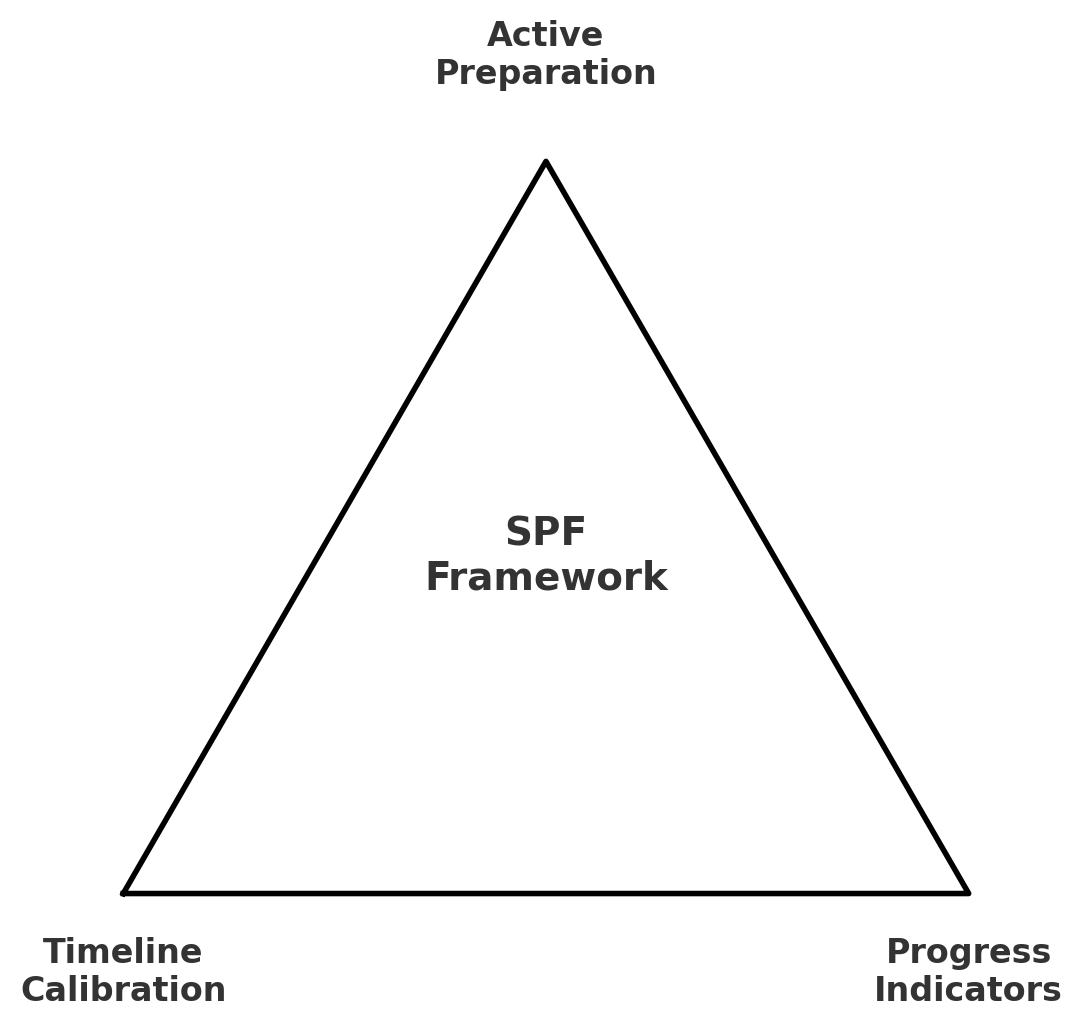
The Strategic Patience Framework provides a structured approach to timing decisions that counteracts our natural psychological biases. It consists of three interconnected components that work together to help founders make better timing decisions.
Timeline Calibration is the foundation of the framework. Instead of setting timelines based on emotions, competitor actions, or arbitrary deadlines, you calibrate your timelines based on data and realistic capability assessments. This means honestly evaluating how long meaningful progress actually takes in your specific context, not how long you wish it would take.
Timeline calibration involves gathering historical data about similar decisions or processes, accounting for the complexity of what you’re trying to achieve, and building in buffer time for unexpected challenges. For example, if you’re planning a product launch, timeline calibration means looking at how long previous launches actually took (not how long you planned for them to take), factoring in the current complexity of your product and team capabilities, and adding realistic buffer time for the unexpected issues that always arise.
Progress Indicators help you track meaningful advancement during waiting periods, preventing the anxiety that comes from feeling like nothing is happening. These aren’t vanity metrics or false productivity measures—they’re genuine indicators that you’re building capabilities and making progress toward your larger goal.
Effective progress indicators are leading measures rather than lagging ones. Instead of just tracking final outcomes, you track the building blocks that lead to those outcomes. If you’re waiting to hire a key team member, progress indicators might include the number of qualified candidates in your pipeline, the quality of your role definition and interview process, and the strength of referral networks you’re building.
Active Preparation ensures that waiting time becomes productive time. This is what transforms strategic patience from passive waiting into competitive advantage building. Active preparation means using timeline delays to build capabilities, gather intelligence, and strengthen your strategic position.
Think of active preparation like a coiled spring—the longer you compress it thoughtfully, the more potential energy you build for explosive action when the timing is right. During product development delays, active preparation might involve deepening customer research, building strategic partnerships, or developing launch capabilities. During fundraising delays, it might mean strengthening unit economics, building investor relationships, or achieving key milestones that improve your negotiation position.
The framework creates a mental model that’s easy to remember:
Calibrate your timeline based on reality, not wishful thinking. Track progress indicators that show meaningful advancement. Use waiting time to build capabilities that compound your eventual success.
Strategic Patience in Action - Real Founder Scenarios
Let’s examine how strategic patience changes decision-making in common founder scenarios. These examples illustrate the framework in practice, showing how the three components work together to create better outcomes.
Waiting for Product-Market Fit: Most founders rush to declare product-market fit based on early positive signals, leading to premature scaling and eventual disappointment. Strategic patience in this scenario means timeline calibration based on cohort data rather than individual customer enthusiasm. Progress indicators include retention curves, engagement depth metrics, and qualitative feedback patterns rather than just signup numbers. Active preparation involves building the operational systems and team capabilities you’ll need when true product-market fit emerges.
Timing a Fundraising Round: The pressure to raise capital quickly often leads to suboptimal terms or poor investor selection. Strategic patience involves calibrating your timeline based on your actual cash needs and business milestone achievements rather than market timing or peer pressure. Progress indicators include improving unit economics, strengthening key partnerships, and building relationships with target investors. Active preparation means using the time before fundraising to achieve milestones that improve your negotiation position and attract higher-quality investors.
Entering New Markets: The temptation to expand quickly into new markets often leads to resource dilution and execution challenges. Timeline calibration means honestly assessing how long market entry actually takes, including relationship building and regulatory navigation. Progress indicators include the strength of local partnerships, early traction from pilot customers, and the development of distribution channels. Active preparation during this waiting period might mean hiring local expertise, adapting your product to cultural nuances, and creating go-to-market playbooks. By the time you enter, you’re not stumbling in—you’re arriving ready.
Making Key Hires: Founders under pressure often hire the first seemingly competent candidate, only to face cultural misfits or underperformance. Strategic patience here means calibrating your timeline around the genuine difficulty of finding top-tier talent rather than arbitrary urgency. Progress indicators could be the number of high-quality referrals, the clarity of your role scorecard, and the rigor of your evaluation process. Active preparation involves building your employer brand, cultivating long-term relationships with potential hires, and strengthening onboarding systems.
Knowing When to Pivot: Impatience drives premature pivots—founders abandon promising ideas too quickly when early results lag. Strategic patience means calibrating timelines based on realistic adoption curves and industry benchmarks. Progress indicators could include meaningful shifts in customer behavior, improving conversion rates, or changes in market signals—not just one bad quarter. Active preparation might involve running structured experiments, building alternative hypotheses, and collecting deeper customer insights before making an irreversible pivot decision.
In each of these scenarios, founders who practice strategic patience don’t move slower; they move smarter. They arrive at key inflection points prepared, positioned, and with leverage their impatient peers lack.
Building Your Strategic Patience Muscle – Daily Practices
Like physical fitness, strategic patience is a muscle that strengthens with deliberate practice. You can’t just decide to be patient in high-stakes situations—you need to train your mind consistently. Here are practical ways founders can build this capacity:
1. Meditation for Impulse Control
Short, daily mindfulness practices help you observe urges without acting on them immediately. Even five minutes a day of focused breathing trains your brain to pause before reacting—a core element of patience.
2. Reframing Waiting as Preparation
When you catch yourself frustrated by delays, ask: What can I build, learn, or strengthen during this time? This simple shift transforms waiting into a proactive advantage.
3. Timeline Visualization
At the start of each quarter, visualize your goals over realistic timelines. Map the steps required, including buffers for setbacks. This reduces anxiety when things take longer than expected because you’ve already accounted for it.
4. Decision-Making Protocols
Adopt a simple rule: no major decision without at least two alternatives, one external perspective, and a defined decision window. This prevents reactive choices driven by impatience.
5. Small Patience Reps
Practice patience in low-stakes situations—like not checking your phone during meetings or delaying a reply to test your ability to sit with discomfort. Over time, these small reps compound into stronger mental stamina.
By embedding these habits, founders condition themselves to see time not as an enemy but as a resource they can shape and harness.
Your Strategic Patience Action Plan
To make this real, here’s a 30-day plan you can start implementing this week:
Week 1 – Awareness
Track moments of impatience daily. Note the trigger, your instinctive reaction, and what outcome you chased. Awareness is the first step.
Week 2 – Application
Choose one decision this week to apply the SPF framework. Calibrate your timeline, define progress indicators, and identify active preparation steps.
Week 3 – Reflection
Hold a 30-minute review session: where did impatience show up? Where did patience pay off? Share your reflections with a co-founder, advisor, or journal them for accountability.
Week 4 – Integration
Build a “strategic patience checklist” you’ll use before big decisions:
Have I calibrated the timeline realistically?
What indicators show real progress?
How can I use this waiting period productively?
By the end of 30 days, you’ll have transformed patience from a vague concept into a structured, repeatable skill.
Key Takeaways
Strategic patience is not passive waiting.It’s active preparation during intentional pauses.
Founder impatience is predictable. It stems from dopamine loops, social pressure, and cognitive biases that can be managed.
The SPF framework offers structure - calibrate timelines, track progress indicators, and leverage active preparation.
Patience is trainable with daily habits like mindfulness, reframing, and protocols build psychological stamina.
Time is your ally but only when you work with it instead of against it, patience compounds into competitive advantage.
Best,
Ashish