

The Operating System Most Founders Don't Have
Two literacies decide how a founder ages. Most build one.

A founder I sat with last week could not figure out why he was failing.
His company was not failing. 14 percent month over month growth. 25 million in ARR run rate. Board thinks he is the best operator they have backed. By every external metric the founder was succeeding.
He was the one quietly failing. He had not slept a full night in fourteen months. He had picked four fights with his cofounder in three weeks. He could not name a single decision he made in the last quarter that he was proud of.
I asked him one question. When was the last time you made a decision you were proud of, without checking with someone first?
He could not answer.
This piece walks you through three things, in order. A map for where every founder sits. A short test you can run on yourself in five minutes. And a move that gets you from one side to both. By the end, you should be able to plot yourself, name what is starved, and know what to do about it this quarter.
The Thesis
There are two literacies that decide how a founder ages.
One is psychological. The ability to know your own state, to make decisions from calm rather than fear, to separate your identity from your company’s monthly performance.
One is financial. The ability to model a SAFE conversion before signing, read a term sheet for the second order effects, and understand what a 2x pref does to your exit at half your last valuation.
Most founders develop one and never the other. The ones who develop both age slowly and decide cleanly. The ones who do not burn out, sell early, or hand control to someone who has both.
The split usually shows up around year three or four. By then the asymmetry is the story.
The Map
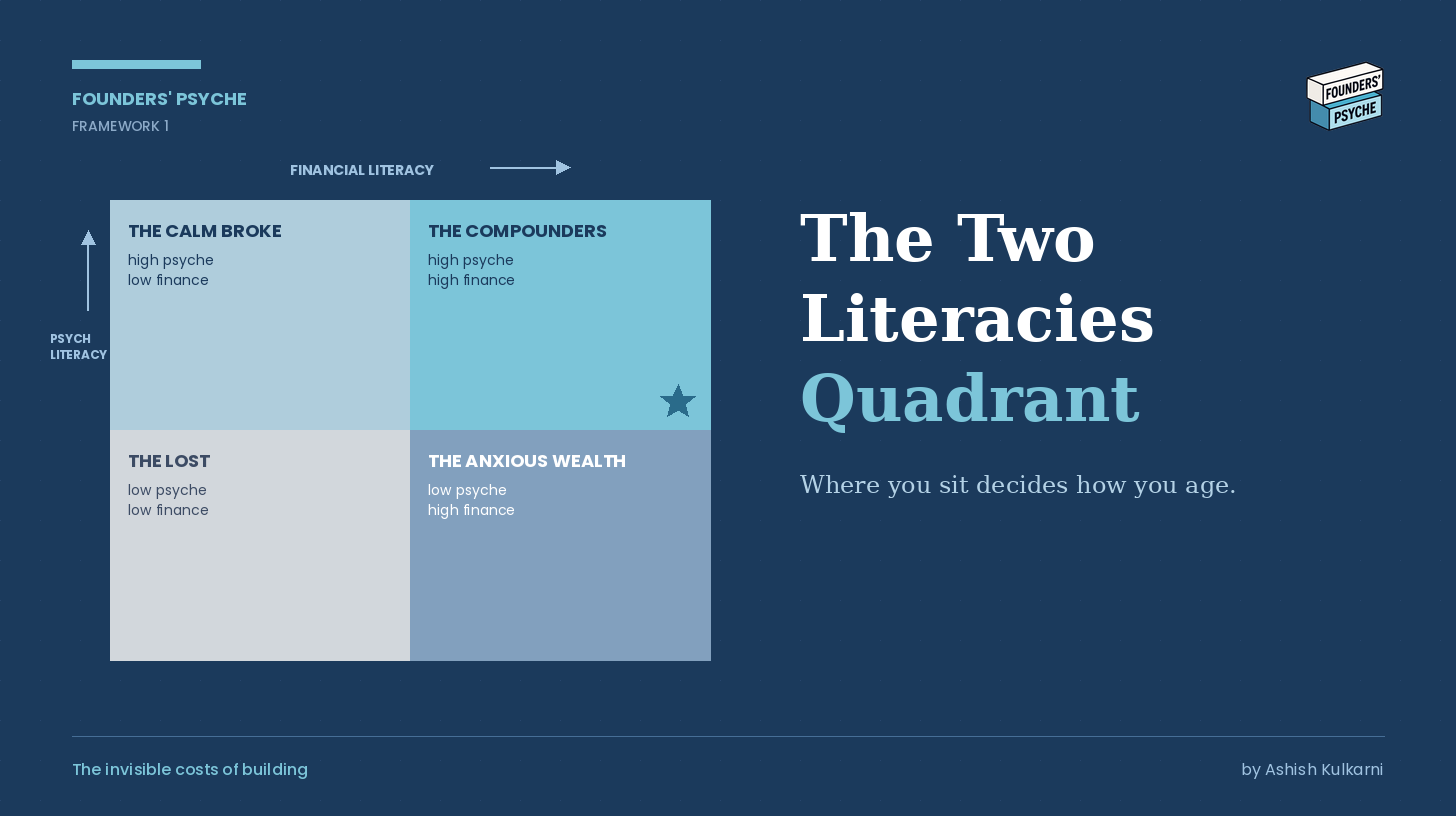
Before you can fix anything, you need a map. Plot every founder you know on this grid.
X axis: financial literacy, low to high. Y axis: psychological literacy, low to high. Four quadrants emerge. I have named the archetypes that live in each one.
The Lost. Bottom left. Low on both axes. Either too early to have developed either, or burning out from both. They sign whatever the lawyer sent them and tell themselves they will sleep when the round closes. They do not.
The Anxious Wealth. Bottom right. High finance, low psyche. They model every scenario. They run the math twice. They cannot tell when they are making a decision from fear. They sign a lead partner whose chemistry they know will rot in two years. They get rich. They get lonely. They cannot enjoy either.
The Calm Broke. Top left. High psyche, low finance. They know when something feels off in the board meeting but cannot name what. They give away two extra points at the next round because they did not model the SAFE conversion forward. They have the inner game. They lose because the outer game eats them.
The Compounders. Top right. High on both. They have a model open and they have a therapist. They walk you through dilution math and they tell you the last time they cried. They take the SAFE math seriously and the cofounder marriage seriously. They are rare. They last.
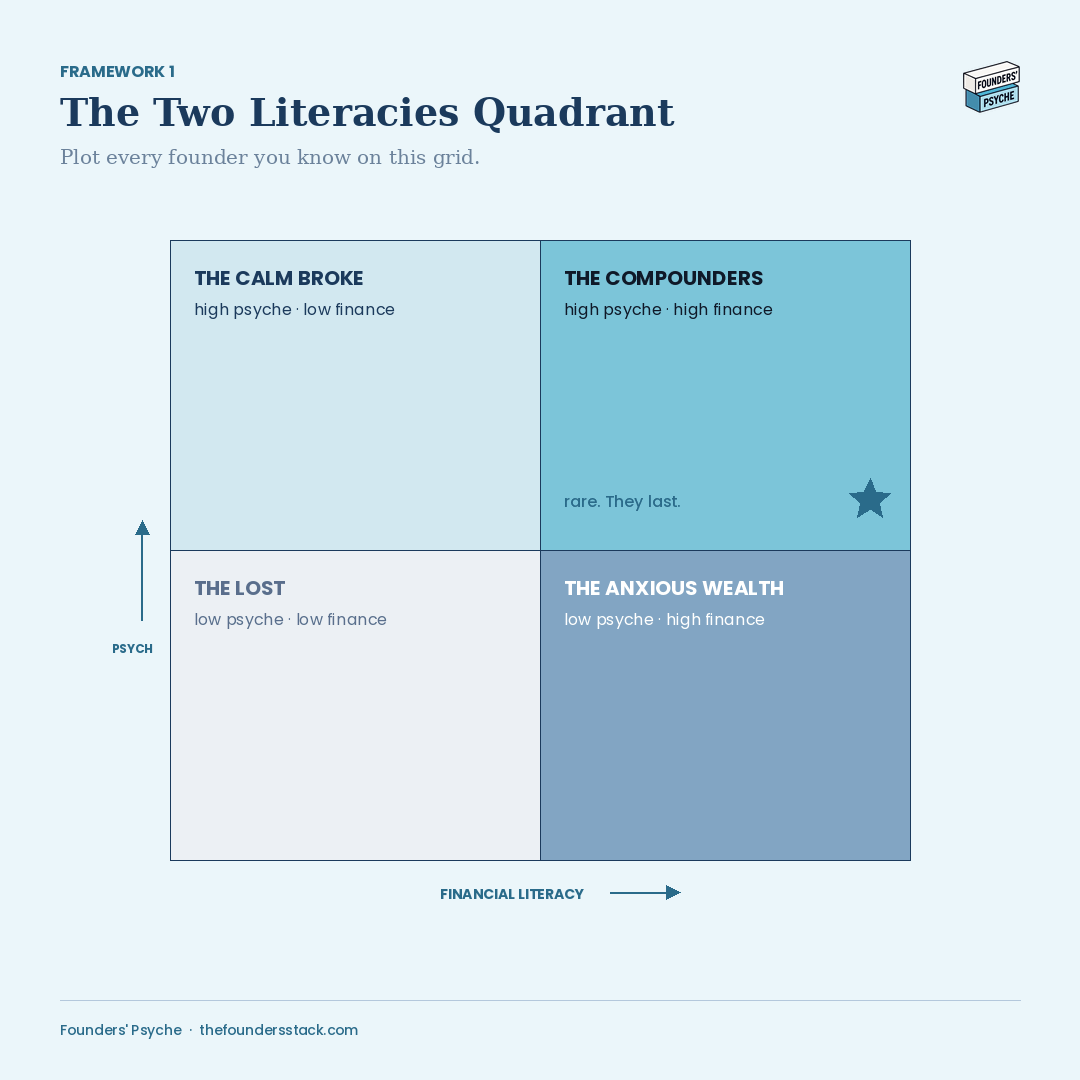
The founder I sat with last week is squarely in the bottom right. The Anxious Wealth quadrant. He has spent four years getting financially literate. He has built no muscle on the other axis. Every external metric says he is winning. Every internal one says he is breaking.
This is the kind of gap that does not announce itself until the consequences arrive. By then it is expensive.
The Test
Knowing the quadrants is not the same as knowing where you sit. Most founders guess their position and guess generously. The test below removes the guessing.
You can run it in five minutes. Score yourself honestly. There is no one to perform for.
Psychological side. Four questions. Score 1 if no, 5 if yes.
1. I made a recent decision alone that I’m proud of.
2. I can step off the dashboard for 48 hours.
3. I know what’s still true about me without the company.
4. I have one person with no financial stake in me.
Financial side. Four questions. Score 1 if no, 5 if yes.
1. I know my cap table at a flat next round.
2. I can model my SAFE at a higher next post.
3. I know when my pref stack hurts me in a soft exit.
4. I read my last term sheet line by line.
Add the scores on each side. You now have two numbers, each between 4 and 20.
Plot them on the quadrant. That is where you sit.
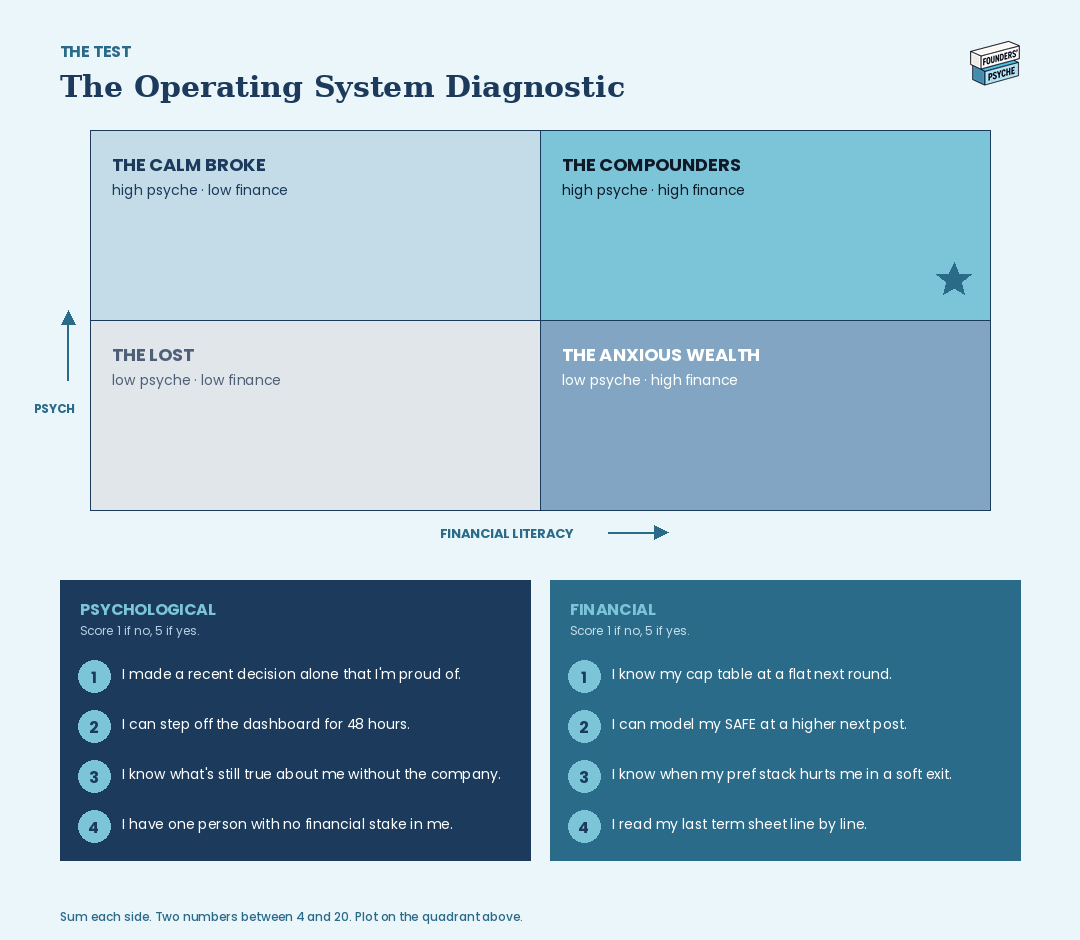
If one number is above 14 and the other is below 10, you are in one of the asymmetric quadrants. That is most founders. Including me, at certain points in my own building.
The diagnostic does not tell you who you are. It tells you which side of your operating system is starved. Knowing that is the first move.
What The Gap Actually Costs
If you scored asymmetric on the test, the next question is the one most founders skip. What does the gap actually cost? Most assume it costs nothing until a round or a board meeting reveals otherwise.
The gap is not abstract. It costs something specific. Both directions show up as bad allocation of two scarce assets.
The psychological gap shows up as bad allocation of energy. The founder who cannot sit with discomfort spends three months avoiding a conversation that needed twenty minutes. The founder with no internal compass spends a quarter chasing a strategy because an investor mentioned it on a call. The founder who confuses identity with company outcomes lights three good employees on fire because a bad week made the company feel like it was dying.
The financial gap shows up as bad allocation of equity. The founder who never modelled their SAFE gives away two extra points at the next round. The founder who never read their pref stack walks away from an acquisition with less than the second engineer they hired. The founder who thinks term sheets are formalities finds out they signed away the right to even see the next round before it prices.
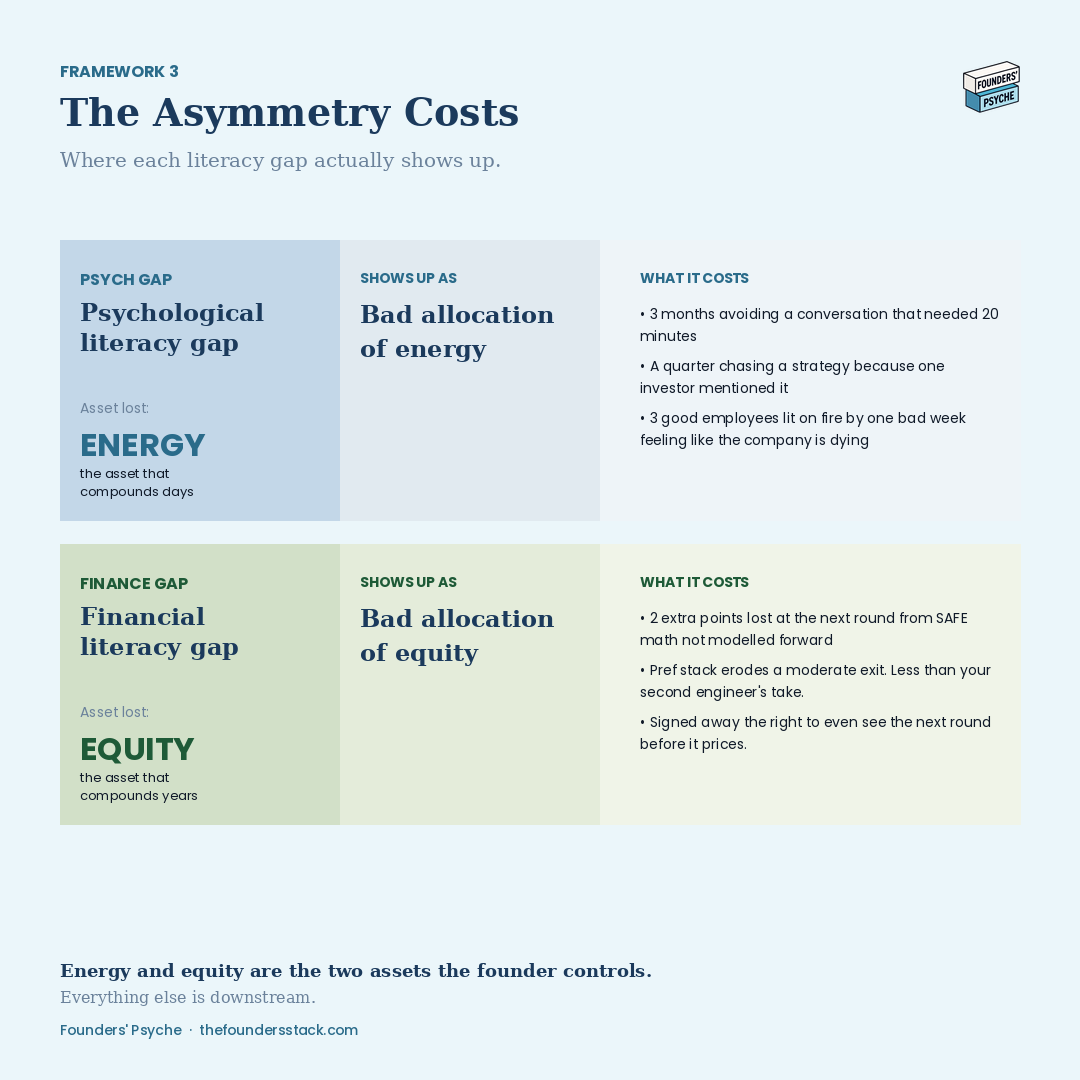
Energy and equity are the two assets the founder actually controls. Everything else is downstream. Strategy is downstream of energy. Capital strategy is downstream of equity. Hiring quality is downstream of both.
The asset map ends at these two. They are the two most founders track the least.
The Move
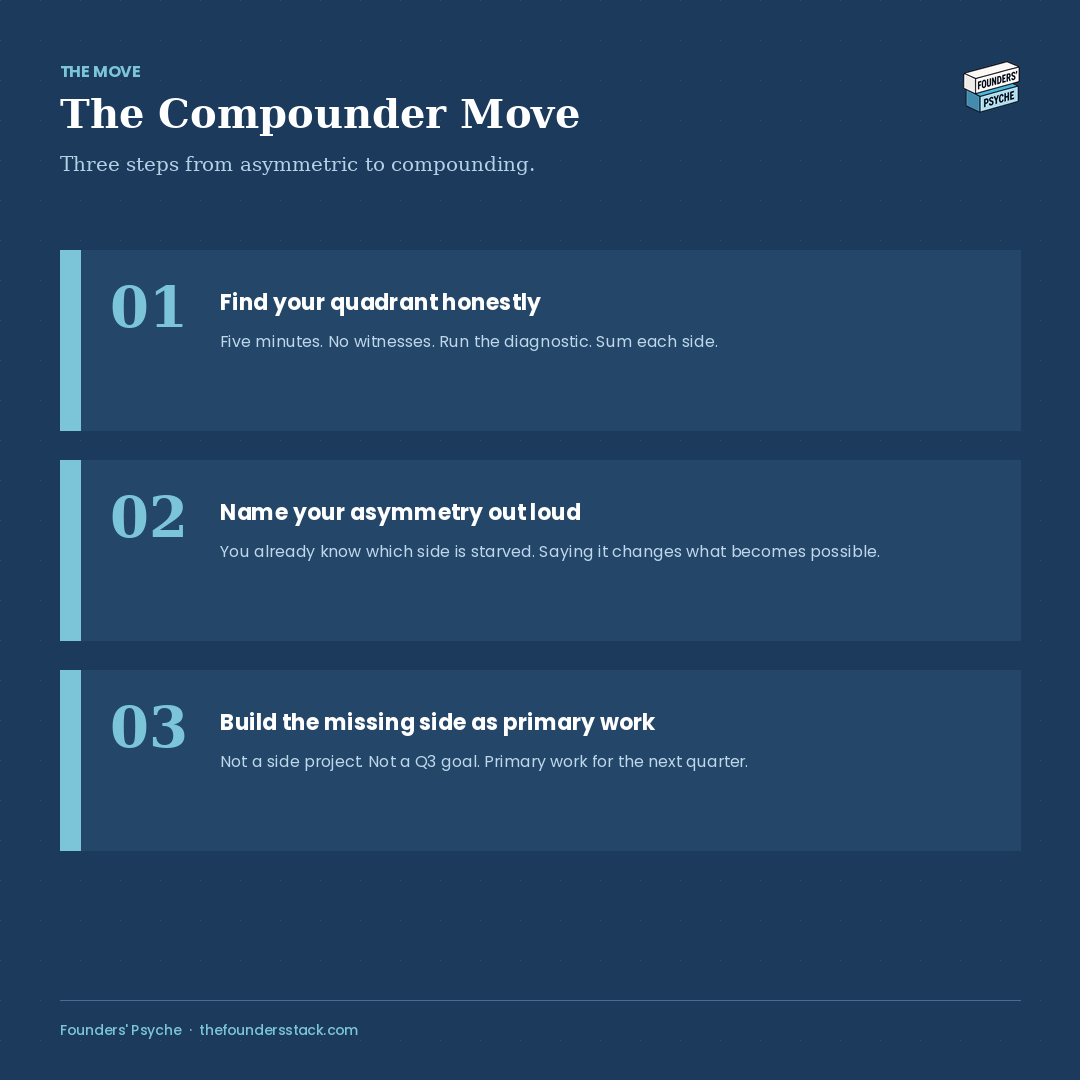
If the map says where you sit, the test says how starved one side is, and the costs say what it is taking from you, then the move is what closes the gap. This is the work the founders in the top right quadrant actually did differently. Three steps, in order.
Step 1. Find your quadrant honestly. Most founders skip this step because the diagnostic feels uncomfortable. Run it anyway. Five minutes. No witnesses required.
Step 2. Name your asymmetry out loud. The thing about asymmetric gaps is that the founder usually knows which side is weak. They have just never said it. Saying it changes what becomes possible.
Step 3. Build the missing side as primary work, in public, with people who can hold you accountable in both directions. Not a side project. Not a Q3 goal. Primary work for the next quarter.
The founder I sat with is starting to do this. He has hired a coach for the psychological side. He has slowed his hiring pace by 30 percent to give himself room to actually sit with the company instead of running ahead of it. He is not fixed. He is starting.
That is the first thing that has to happen. You cannot fix what you cannot see.
The Choice
The founder who lasts is the one who refuses to be financially literate while being psychologically broken. And the one who refuses to be psychologically calm while being financially asleep.
Both. At the same time. Or it does not compound.
Most founders do not have an operating system. They have two halves of one, taped together, and they wonder why everything is so heavy.
You are not heavy.
You are running on half.
Run the diagnostic this week. Plot your quadrant. Tell one person what your asymmetry is. That is the entire first move.
PS: I am still working on lab notes, just focusing more the financial tools first…will then focus on psyche tools!
Best,
Ashish