

Lab Notes #2: Locus of Control
The quiet one. The one that actually shows up when things get hard.

It has been a while since I last wrote. I figured I could just start working on the framework as I do the research, so I have been busy building the tools, now for every lab notes, if I do decide to add it to my framework - I will share a link so each one of you can try it for free.
I have prepared a tool to measure your dark triad scores. Here is the link if anyone wants to try it - it is free!
At the end of the Dark Triad note, I said I expected Locus of Control to be a stronger predictor. Having gone through over 60 studies and multiple meta-analyses on this, I was right. But not quite in the way I expected.
(A meta-analysis, if you haven’t come across the term before, is a study of studies. Instead of running one new experiment, researchers collect all the existing research on a topic and statistically combine the results. Think of it as averaging the findings across dozens of experiments so you’re not relying on any single one. It gives you a much cleaner picture of what’s actually true.)
Julian Rotter coined the term in 1966. The concept is simple. Internal locus of control means you believe your outcomes are shaped by your own actions. External means you believe they’re shaped by luck, powerful others, or the system. Rotter built a 29-item questionnaire to measure it and that questionnaire has been used in thousands of studies since.
The research on this one is substantially larger than the Dark Triad literature. 60+ validated studies. Multiple meta-analyses. Data across cultures, genders, stages of founding, and economic contexts. When something has been studied this much, the signal starts to separate from the noise.
Here’s what the signal says.
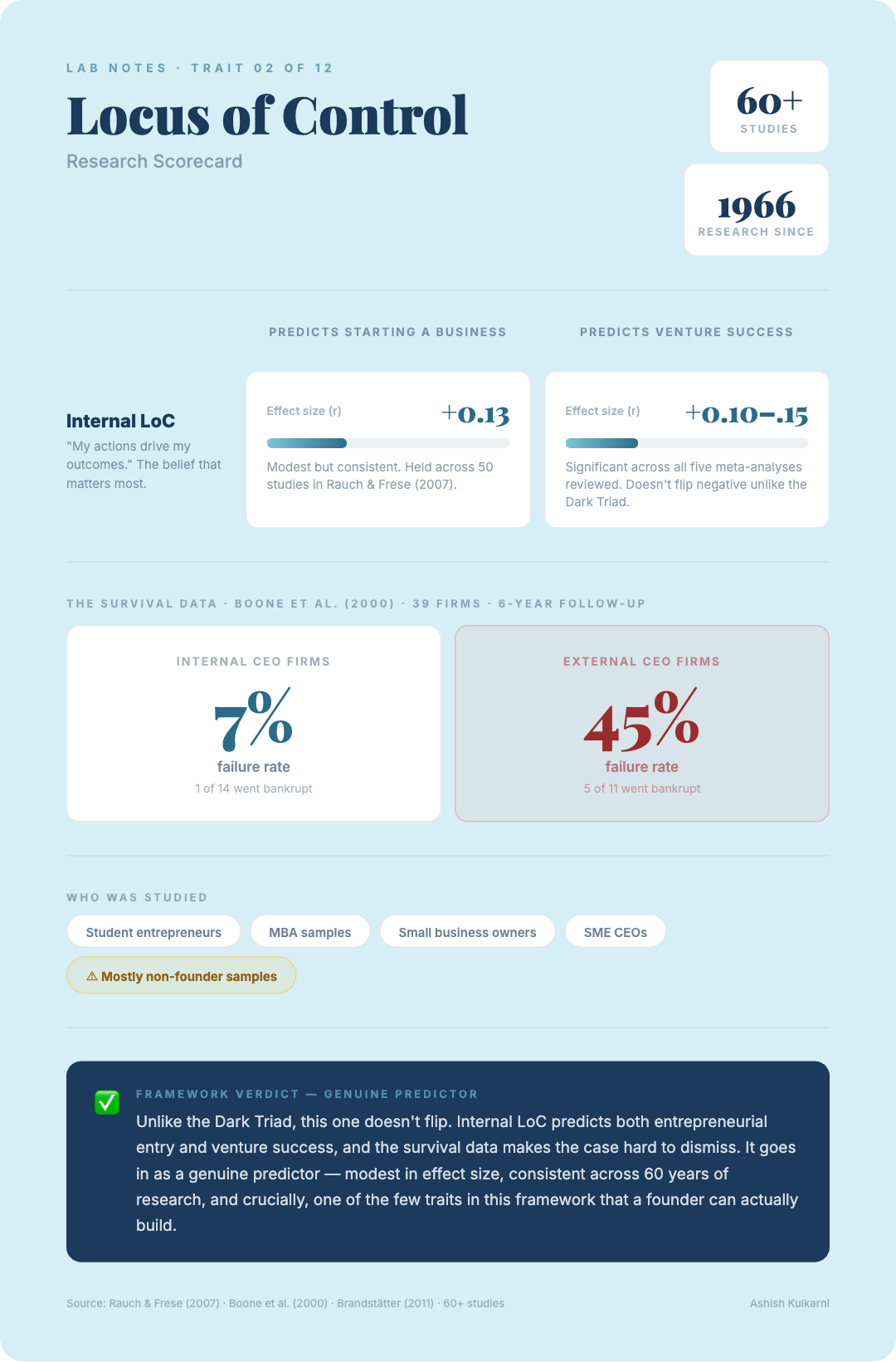
The number I keep coming back to isn’t from a meta-analysis. It’s from a survival study. Boone et al. followed 39 firms over six years. Among firms led by internally-oriented CEOs, 1 of 14 went bankrupt, a 7% failure rate. Among firms led by externally-oriented CEOs, 5 of 11 failed, a 45% failure rate. That is not a subtle difference, it is a fundamentally different outcome.
The meta-analysis picture is more modest. Rauch and Frese (2007), which is the most rigorous analysis on this, pulled together 50 studies and found that internal LoC correlated with business creation at r = .13. The r here is a correlation coefficient, which is a number between 0 and 1 measuring how strongly two things are linked. A score closer to 0 means almost no relationship. A score closer to 1 means a very strong one. So .13 is modest but it’s real. In the Dark Triad notes, I showed narcissism scoring 0.24 for starting a company. Internal LoC scores lower on that measure. But here’s the critical difference: the Dark Triad flipped negative on performance. LoC doesn’t flip. It’s smaller but it holds.
Brandstätter (2011) reviewed five separate meta-analyses and found LoC showed significant correlations with both business creation and success in all five. Self-efficacy and need for achievement are both stronger predictors, with correlation scores in the .25 to .38 range. But LoC appears consistently across every meta-analysis that has looked at it. That kind of consistency is worth something.
There is something else worth understanding about how it works. LoC rarely acts as a direct predictor. It operates through what researchers call mediating pathways. A mediating pathway is basically a chain of cause and effect: LoC doesn’t directly cause success, but it causes other things that do. The founder who believes their actions drive outcomes tends to spot more opportunities, build stronger networks, develop their skills more deliberately, and bounce back from failure more readily. LoC is the root belief. Everything else grows from it.
One finding I didn’t expect: LoC is malleable. Hansemark (1998) ran a 9-month entrepreneurship programme and found it produced statistically significant increases in internal LoC. Statistically significant means the result was unlikely to be due to chance. This is not how we usually think about personality traits. The Big Five personality framework, which is the most widely used model in psychology, treats traits like extraversion or conscientiousness as largely stable across a lifetime. LoC appears to move. That has real implications. It means this isn’t fixed wiring. It’s something founders can work on.
Two honest caveats.
Gender:
The gender picture is complicated. A rare 11-year longitudinal study by Hansemark (2003) found LoC predicted business start-ups for men but not women. A longitudinal study measures the same people over a long period of time rather than just taking a snapshot, which makes its findings harder to dismiss. The mechanism here isn’t fully explained. This doesn’t mean LoC is irrelevant for women founders and other studies do find it significant, but the longitudinal data adds a layer of uncertainty worth flagging.
Culture:
The cultural picture is also complicated. In Ghana, both internal and external LoC predicted entrepreneurial intention, with external LoC having the stronger effect. The researchers suggest that in developing economies, necessity can channel externally-oriented individuals toward entrepreneurship just as powerfully as internal conviction does elsewhere. LoC appears to work differently depending on the structural context people are operating in.
Same caveat as before: very few of these studies used actual founders. Most used students or MBA cohorts. I’m treating the findings seriously but not as settled law.
So does it go into the framework?
Yes. As a genuine predictor of both starting and sustaining a venture. Not a warning flag like the Dark Triad but an actual green signal. The effect sizes are modest, but they’re real, consistent across 60 years of research, and they point in the same direction for both entry and performance. The survival data is particularly hard to dismiss.
The more interesting implication: if LoC is malleable, then it belongs in the framework not just as a trait to assess but as a capability to develop.
Check out your Locus of Control Score below
Next up is Self-Efficacy. Early signal: this one has the strongest effect sizes of anything in the framework so far.
PS: I have recently started preparing tools like the LoC and Dark Triad that I have shared in this blog, if you can provide any feedback- good or bad are appreciated!
Best,
Ashish